
Going away together is great.
Planning it together, less so.
“I really don’t mind either way.”
Everyone is flexible until a proposal appears. Then it turns out someone cannot make that week after all, and you start over.
“Shall we sort that later?”
The fun decisions move fast, the dull ones slide. Two weeks before departure there is still no rental car.
“I already paid for that.”
One books the house, another the tickets, a third buys groceries. Working out who owes what afterwards costs an evening.
All three have the same root cause: no owner per area, and no shared place showing where things stand.
Four agreements that make the difference
Make these at the start, not along the way. Together they take twenty minutes and save weeks of back-and-forth.
- One owner per area Transport, accommodation, activities, food, costs: assign one person per area who decides. That person still consults, but makes the final call. Deciding as a group usually means not deciding.
- Dates first, wishes second Ask everyone for available days before you talk destinations. Otherwise you build excitement for a trip the calendar never allowed.
- A per-person amount, said out loud Name a concrete target figure including transport, accommodation and activities. People on a tighter budget rarely raise it themselves, but will respond to a number on the table.
- One place for everything Schedule, packing list, bookings and costs in the same place — not spread over a group chat, two inboxes and someone’s notes app. This is the agreement that makes the other three work.
Planning with your partner
With two people the trap is not disagreement but an uneven split. Often one of you arranges nearly everything and the other only notices when something goes wrong. That is not a matter of willingness: whoever starts knows the most and therefore keeps hold of it.
The simplest fix is to divide tasks out loud rather than letting them settle. One handles transport and documents, the other accommodation and activities. And once the packing list is shared, the other person can actually help without asking what is already on it.
Planning with your family
With children involved, planning shifts from *where shall we go* to what do we all need. The volume of stuff grows faster than the boot space, and most of the stress lands in the final week.
What helps: give older children their own section of the packing list. They pack their own clothes and games, and you keep an overview without checking everything. The full list by age is on the packing list for a holiday with kids.
Also plan deliberately less than you would like. A day with children has roughly two thirds of the capacity of a day without.
Planning with friends
In a group of friends the sensitive point is almost always money — not because people are stingy, but because budgets quietly differ. Someone who finds every restaurant expensive will not say so in the group chat.
So agree two things upfront: a target amount per person, and how you settle up along the way. One shared pot, everything reconciled afterwards, or everyone for themselves — which agreement you make matters less than making one.
For larger groups (more than two households) there is a fuller group trip step-by-step guide.
Who does what? A task split that works
Copy this split or adapt it. What matters is that every task has a name behind it.
| Task | Owner | Done by |
|---|---|---|
| Setting dates | Everyone submits free days; one person decides | 6 months out |
| Agreeing the budget | The costs owner | 5 months out |
| Booking transport | One person, after budget sign-off | 4 months out |
| Booking accommodation | One person, after transport | 4 months out |
| Checking documents | Each household for itself | 3 months out |
| Activities and reservations | One person, with input from the rest | 1 month out |
| Packing list and split | Together, in one shared list | 3 weeks out |
| Tracking costs | Everyone logs their own spending | Ongoing |
What that looks like in PAKT
You create the trip once and invite your partner, family or friends. Everyone sees the same schedule, the same packing list and the same bookings — and can add to them.
For each packing list item you record who is bringing it. Expenses go in as you make them, so by the end it is clear who owes whom.
Download PAKT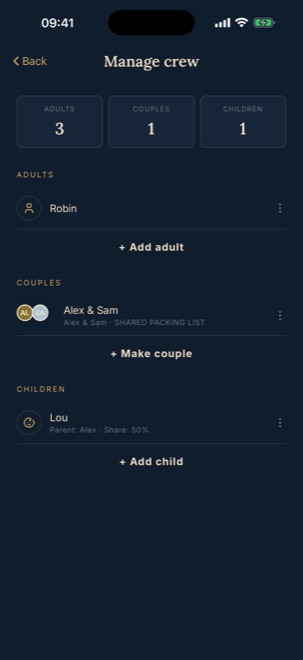
Agreements checklist for your travel party
Go through this once together. What you tick off here you will not have to sort out on the road.
Read next
One place for your whole trip
Create your trip in PAKT, invite your partner, family or friends and keep the schedule, packing list and costs together. Nobody needs catching up any more.
Download PAKT