
When does a group outgrow the group chat?
Somewhere between four and six people. Below that everyone still follows the conversation; above it half the group reads without replying and the rest assumes silence means agreement. The tipping point is not the number of messages but the number of decisions you need to be able to find again.
A group chat is an excellent place to talk and a terrible archive. Group travel needs both: talk where you already talk, but put the outcome — who books, who drives, who brings the tent, who paid for what — somewhere it will still be in two weeks.
Six things that only matter with a group
With two people these barely register. From six up they decide whether the app still gets used after one trip.
- Can everyone join without paying? This is the big one. An app the rest of the group needs a subscription for will not get used — half of them fall back to the group chat and you are worse off than before.
- Can everyone add things, not just read? Otherwise one person keeps entering everything and you are back to the organiser doing it alone. With a group, read-only is not enough.
- Are costs and planning the same app? Two separate apps means half the group installs one of them. Who fronted what belongs to the same trip as who brings what.
- Can you set unequal shares? Group trips rarely consist of adults splitting everything evenly. Children count for less, someone joins for three of the seven days, and not everyone does every outing.
- Does it work offline? With a group it fails at exactly one moment: arrival. Everyone looks up the address at once, somewhere with poor signal. An app that fetches everything live is useless right then.
- Does it survive to next time? Groups that travel together once usually do it again. If every trip starts from scratch, nobody opens it a second time.
Group chat, spreadsheet or a group travel app?
How most groups do it now, and where that runs aground.
| Group chat | Shared document | Group travel app | |
|---|---|---|---|
| Discussing | Excellent | Awkward | Stays in the group chat |
| Finding a decision again | Near impossible | Reasonable | Yes |
| Everyone sees the same thing | Only if you scroll back | If you share it | Always current |
| Who brings what | Scattered messages | Manually | Recorded per item |
| Splitting costs | Screenshots of payment requests | A tab with formulas | Built in |
| Children at half a share | Manually | Build a formula | Set per person |
| Offline on arrival | Partly | Usually | Yes |
| Reuse for the next trip | No | Copy and clean up | Template or copy |
What PAKT does
PAKT is built for families and groups travelling together. You create the trip once, invite everyone and fill in the packing list, plans, trip info and costs together. Joining is free: the people you invite do not need to buy anything.
For each member you record who they are, who they belong with and what cost share they carry — children count for less by default. The packing list records who brings each item, so you do not end up with three hairdryers and no adapter.
Download PAKT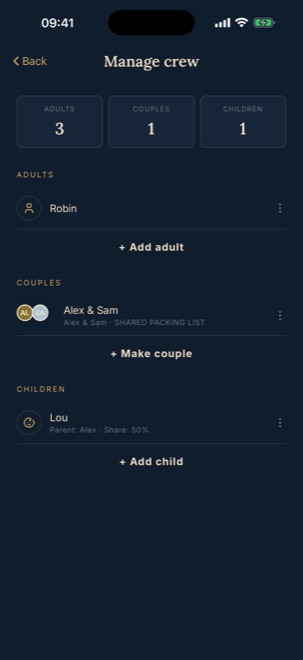
What PAKT does not do
PAKT does not book anything. No flights, no houses, no rental cars, and there is no price comparison in it. You book the way you always do and put the confirmation into the trip afterwards.
It is also not a chat: you keep discussing where you discuss now. PAKT is where the outcome of that discussion lands. And it is not a corporate travel tool — no expense claims, no approvals, no invoices.
Amounts are shown in euros, so for a trip where you pay in several currencies you will need to convert yourself. One thing that does work in a group’s favour: PAKT is on both the App Store and Google Play, so everyone can join whatever phone they carry. Beyond that: no tracking and no ads. The core features are free and PAKT Pro is a one-off purchase, not a subscription.
Read next
Organise your next group trip in one place
Create the trip in PAKT and invite the whole group. Packing list, plans and costs together — and joining is free.
Download PAKT