
Nobody wants to be the bookkeeper.
So nobody is.
“Don’t worry about it.”
Kindly meant, but it adds up. Say it three times and by the end of the week you feel like you paid for the holiday.
“I’ll send it through later.”
The receipts sit in four phones. On the last evening someone tries to rebuild it all from a bank statement.
“Do the kids count too?”
Dividing by the number of people is simple, but not fair. A four-year-old does not eat an adult portion or pay full entry.
The problem is almost never the split itself. It is that the admin sits with one person and only starts once the holiday is already over.
How to split costs without the friction
Five agreements, made before you leave. They take ten minutes and remove the conversation on the last evening.
- Agree what goes in the pot and what does not Shared: accommodation, transport, groceries and group outings. Personal: souvenirs, drinks outside the group, that diving trip two of you did. Without this, you will later argue over every receipt.
- Set each person’s share By default everyone counts as one. Children often count as half, and someone joining for three of the seven days counts proportionally. Agree it upfront — afterwards, every correction feels like an accusation.
- Have everyone log their own spending, immediately This is where it breaks in practice. One person tracking everything becomes the bookkeeper and misses half of it. Log an expense the moment you pay, along with who paid.
- Do not settle every day Sending a payment request every evening makes it more awkward, not less. Let the amounts stand and settle once at the end — most of them cancel each other out anyway.
- Settle within a week of getting home The longer you wait, the smaller the chance it happens at all. Pick one moment, send the amounts round and close it off.
Four ways to split the costs
Compared honestly. For two people on a weekend away the first column is fine — it only strains as the group grows.
| From memory | Spreadsheet | Dedicated costs app | Inside your trip app | |
|---|---|---|---|---|
| Works for two people | Yes | Yes | Yes | Yes |
| Works from six people up | No | Barely | Yes | Yes |
| Everyone enters their own | No | Rarely | Yes | Yes |
| Child counts as half a share | Manually | Build a formula | Sometimes | Built in |
| Skip someone on one expense | From memory | Extra column | Yes | Yes |
| Fewest possible transfers | No | Work it out yourself | Yes | Yes |
| Sits with your packing list and plans | No | No | No | Yes |
| Extra app for the group to install | None | None | Yes | No |
When should someone count for less?
Splitting equally is the easiest agreement, but rarely the fairest. The rule of thumb: someone counts for less when they demonstrably consume less, not when they have less to spend. That second one is a separate conversation.
In practice it is almost always about children. A common split is half a share up to around twelve and a full share after that — from that age they eat adult portions and pay full entry. Accommodation works differently: a child on a camp bed does not cost an extra room.
Other cases that keep coming up: someone joining for only part of the trip, someone who does not drink while the wine comes out of the shared pot, and the outing half the group skips. For that last one there is a simpler fix than a separate percentage: take that person out of that single expense, rather than lowering their share across the whole trip.
Who owes whom?
In PAKT everyone adds their own expenses and picks who paid. You set each person’s share — children count for less by default — and anyone who sat an expense out is simply left off it.
At the end PAKT reduces it to the fewest possible transfers: not everyone paying everyone, but two or three payments. Tap a row to send a payment request over WhatsApp. And anyone who wants to check the maths opens View calculation and sees exactly how each amount was built up.
Download PAKT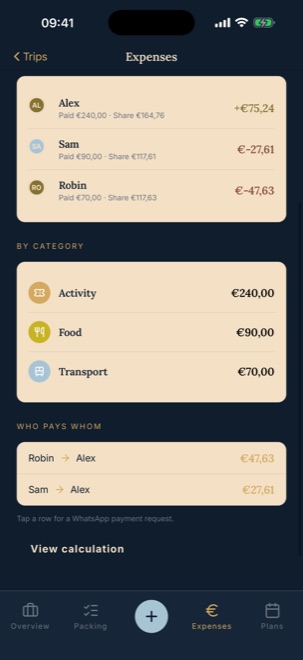
Checklist: agree before you go
Run through this once with the group. Ten minutes, and the last evening is no longer about money.
Read next
No more working it out on the last evening
Add expenses in PAKT while you are away. At the end you see at a glance who owes whom — with children counting for half a share.
Download PAKT